Monogram Dishwasher Will Not Start: Latch, Lock, Delay, Water
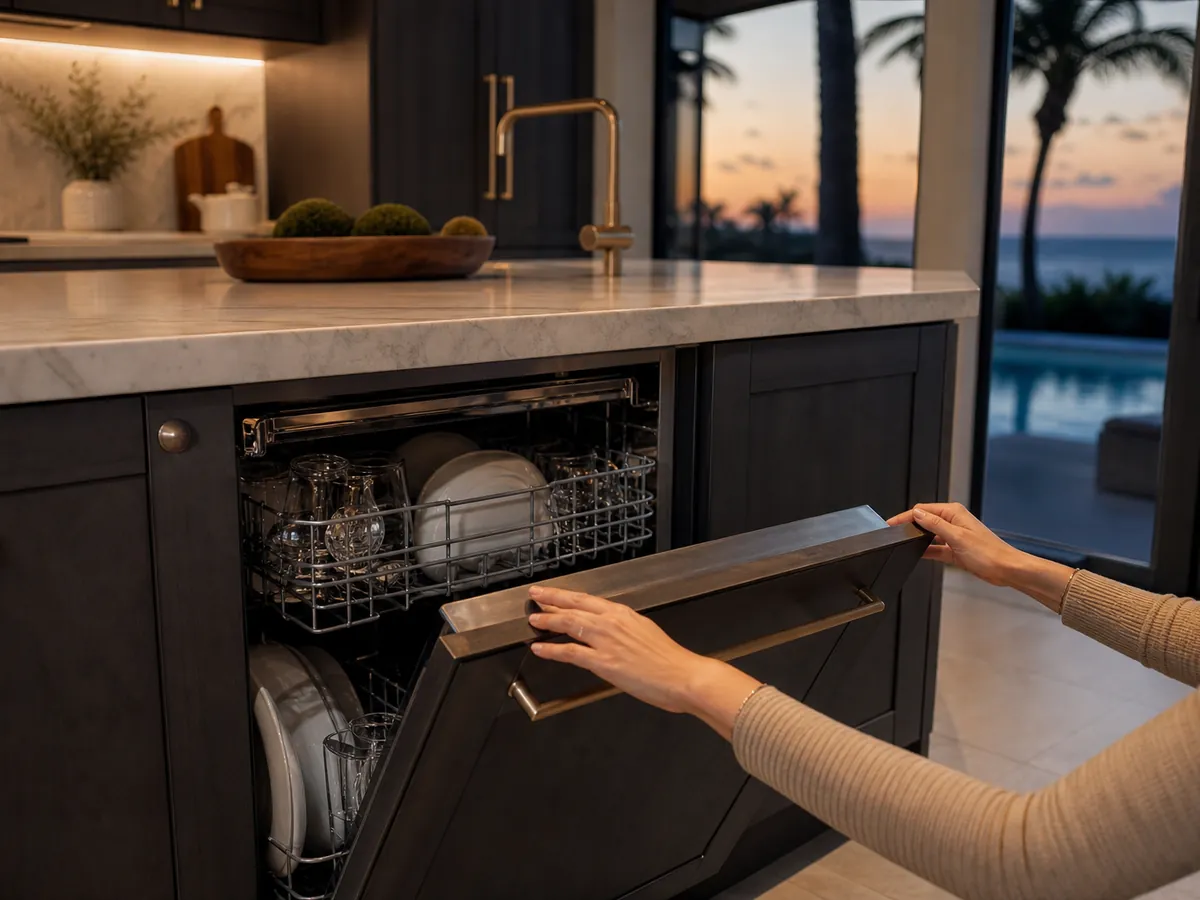
A Monogram dishwasher that will not start is most often waiting on something simple: a door that did not fully latch, a control lock that is on, a delay start that is still counting down, or a water supply that is shut. Check those four in order. If none applies, switch off the breaker and call.
Is the door latched all the way?
The dishwasher will not begin a cycle unless the door switch confirms the door is closed. A built-in Monogram dishwasher sits flush with the cabinetry, and a rack, a tall dish or a utensil handle can hold the door a fraction open without looking wrong.
Open the door, make sure nothing sticks out of the racks or blocks the door seal, then close it firmly until you hear the latch catch. Press Start again within a short time, since many controls cancel a selection if the door is left open. Also glance at the door gasket for a fold or food residue, and wipe it clean.
Could the control lock be on?
The control lock exists to stop children or stray touches from changing a cycle. When it is on, the keys do nothing, and the dishwasher can seem dead even though the display lights up. Look for a lock icon or message on the display.
Your use and care guide shows how to release the lock on your model, usually by holding a specific key for a few seconds. Follow the guide rather than guessing at button combinations. After you release the lock, select a cycle and press Start again.
In a home that was closed for the summer, a control lock may also have been left on, so it is worth checking first when you return.
Is a delay start or a different setting hiding the problem?
A delay start tells the dishwasher to wait before running. The display may show a countdown or a delay indicator, and the machine will look idle until it ends. If you did not mean to delay, cancel the delay option or change the selection and start again.
Some selections also need an option turned off before the cycle runs, and some controls reset the cycle if a key is pressed twice. If you are unsure what the display means, look up the indicator in your guide, and write down any message so you can describe it exactly if you call.
What if the water supply is the issue?
A dishwasher will fill, run, then drain. If water cannot enter, the control may stop the cycle or never begin it. The usual owner-level reasons are a closed supply valve under the sink, a kinked supply line, or a household water interruption.
Before touching anything under the sink, switch the dishwasher breaker off. Look at the supply valve and confirm the handle is in line with the pipe, which is the open position on most valves. Do not remove the dishwasher, tilt it or open the lower panel, and leave the hose connections alone.
Homes on private wells, which exist in rural parts of Tampa Bay counties, can lose water when the pump or its power is interrupted. If you have a well, check that the household pump is running before you suspect the dishwasher.
What do the common causes look like side by side?
| What you notice | Likely cause | What you can check | Next step |
|---|---|---|---|
| Nothing happens, no click | Door not latched | Clear racks, close firmly | Call if the latch is loose |
| Display lit, keys unresponsive | Control lock on | Release it per the guide | None once released |
| Display shows a countdown | Delay start active | Cancel the delay | None once canceled |
| Hums but no water enters | Supply valve closed or line kinked | Check the valve, power off first | Call if the valve is open |
| Display dark, breaker on | Power or control board | Confirm the breaker is not tripped | Technician visit |
| Starts, then stops quickly | Sensor, pump or drain problem | Note any message shown | Technician visit |
When should you call a technician?
Call when the door is closed and latched, the control lock and delay are off, the water is on, and the dishwasher still will not run. At that point the cause is probably a door latch switch, a control board, a motor relay or a pump, and none of those can be checked safely without opening panels.
Call right away if you see water leaking under the unit, smell burning, or find the breaker tripping when the dishwasher tries to start. Switch the breaker off and turn the supply valve to the closed position. Water inside a built-in cabinet can reach the floor and the cabinetry quickly.
We test the latch switch, the control response, the fill valve, the pump and the wiring, and we run a cycle before we leave. If you want to know how this affects your warranty, check your warranty terms. Independent service does not by itself void a warranty.
Frequently asked questions
Why does my dishwasher click but not run?
A click can be the latch or a valve responding, which means the control is getting power. If the cycle still does not run, a door switch, a fill problem or a motor relay may be involved and a technician should look.
Will unplugging the dishwasher reset it?
A built-in dishwasher is often wired directly, so the safe reset is the breaker, not the plug. Switch it off for a few minutes, switch it back on, and try a cycle. Do not pull the dishwasher out to reach a plug.
Can a storm outage stop a dishwasher from starting?
Yes. After an outage the control restarts and may show a message or ignore keys for a short time. A breaker reset usually clears it. If the display stays dark after the reset, a surge may have affected the board.
Is it safe to run the dishwasher if it leaks a little?
No. Even a small leak can damage the floor and cabinets. Stop the cycle, switch off the breaker, close the supply valve and have the leak traced before you run it again.