Anti-tip brackets on Monogram freestanding ranges: why they matter
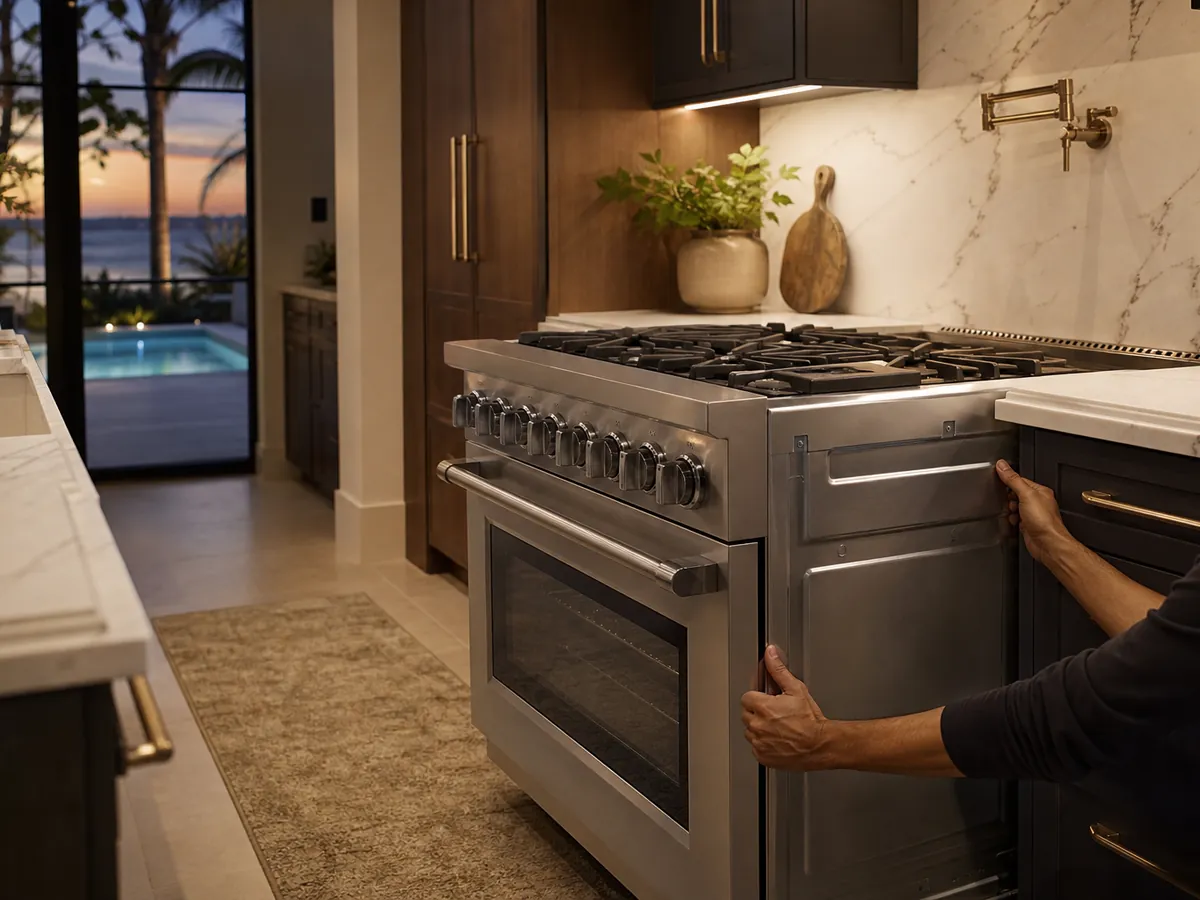
An anti-tip bracket is a small metal part that holds a freestanding range to the floor or wall so it cannot tip forward when weight lands on an open oven door. It matters because a range is heavy at the back and a loaded door can shift that balance. Confirm that your Monogram range has one and that it is engaged.
Why does a freestanding range need an anti-tip bracket?
A freestanding range stands on its own legs. When the oven door is open, its weight hangs out in front of the legs. A pot of boiling liquid sitting on the door, a child climbing on it, or an adult leaning on it can move the center of gravity far enough to tip the range forward. The result can be spilled hot food, burns, and injury.
The bracket stops that. It anchors the range, usually at a rear leg or the back edge, so that the range cannot lift at the front. Your Monogram installation instructions describe the bracket that came with the range and how it should be fastened. Treat it as a required safety part, not an accessory.
Why might a bracket be missing or not engaged?
Several ordinary situations leave a range without protection. The installer may have skipped the bracket or fixed it in the wrong spot. A kitchen remodel or new flooring may have meant the range was pulled out and pushed back without re-engaging the rear leg. Cleaning behind the range is another common reason it gets moved. A range moved during storm preparation, or for repairs to the floor after water damage, can end up unanchored.
There is also the matter of a range moving into a rental or a vacation home. If a seasonal residence changes hands or gets a new range, the old bracket may not match the new unit. Ask whoever installed it to confirm the fastening, or have a technician check.
How can you check an anti-tip bracket safely?
Before any check, make sure the oven is off, the cooktop is cool, and nothing is on the door or cooktop. The goal is observation, not a stress test. Never stand or sit on the open door to see whether the range tips, and never place weight on it to test it.
- Read the installation section of your use-and-care guide to learn where the bracket sits on your model and how the rear leg should engage it.
- If the guide describes a way to view the bracket, such as through the bottom drawer opening with a flashlight, follow it.
- Look for the bracket and the leg that should slide into it, and confirm both are there.
- Do not pull the range out from the wall to look behind it. Doing so strains the gas connector or the power cord, and can damage the floor.
- If you cannot see it, or you are not sure, treat the range as unprotected and stop leaving the door open under load until a technician confirms it.
If you ever smell gas while checking, leave the home, avoid switches, and call the gas utility or 911 from outside.
What does a technician do about it?
With the oven off and the range cool, a technician confirms that the bracket is installed in a suitable place and fastened to a solid surface, and that the rear leg is engaged. If the range has to be moved, we shut off the gas at the valve or the power at the breaker first, then handle the connector with care and test the joints afterward. Where a bracket is missing, we explain what your guide calls for. We give a written price before any work starts.
Do not expect a bracket to fix other problems. A wobbly range may also need its legs leveled, a task your use-and-care guide describes.
What should you look at, and what should you do?
| Situation | Risk | What you can check | Next step |
|---|---|---|---|
| New range just installed | Bracket skipped or misplaced | Read the guide and confirm the bracket was fitted | Ask the installer or a technician to verify |
| Range moved for cleaning or floors | Rear leg no longer engaged | Look through the drawer opening if the guide shows it | Have it re-anchored |
| Range moved after a storm or flood | Bracket loose, corroded, or bent | Photograph and avoid heavy loads on the door | Technician inspection |
| Children in the home | Climbing on the open door | Keep the door closed when not in use | Confirm the bracket is engaged |
| Cannot see the bracket | Unknown protection | Treat it as unprotected | Schedule a check |
What habits lower the risk on a freestanding range?
Keep heavy pots off the open door and close it when you finish. Do not let children climb or sit on it. Use the racks instead of the door as a shelf when you pull a heavy roasting pan. Check the bracket every time the range has been moved, for any reason, and check it again if you replace the floor.
It also helps to note the bracket in your records. Take a photo of the engaged bracket after a trusted check, and keep it with your model and serial information. If you ever sell the home or hire a cleaner who moves appliances, that photo makes it easy to confirm nothing changed.
Frequently asked questions
Do slide-in or built-in ranges need an anti-tip bracket?
Freestanding ranges are the focus here. Other styles may use different anchoring, and your installation instructions tell you what your model needs. Follow the guide for your exact unit, and ask a technician when it is unclear.
Can I install the bracket myself?
Fastening a bracket to a floor or wall is not the same as working on wiring or gas, but moving a gas range can stress the connector. If the range has to be pulled out, have a technician do it with the gas shut off and the connection tested afterward.
Is a range without a bracket covered by a recall?
A missing bracket is usually an installation matter, not a recall. The CPSC recalls page lists current product notices. Search it for your model, and check your warranty terms if the range is new.
Does a bracket stop the range sliding?
It is built to prevent forward tipping, not to hold the range in place against every push. Level legs and a firm floor help too. Check your guide for how to level the range.