Monogram refrigerator food safety after a power outage
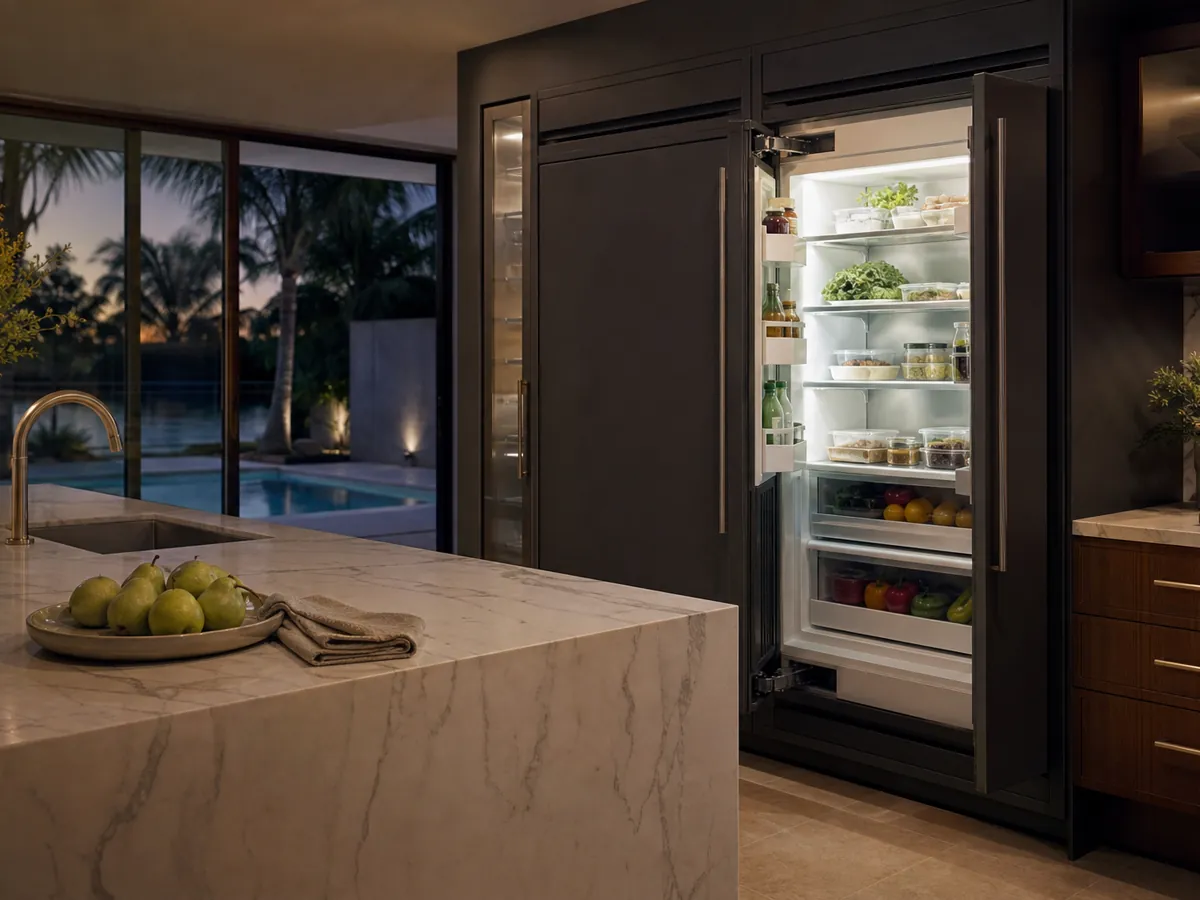
After a power outage, judge the food in your Monogram refrigerator with a thermometer and a clock, not your eyes or nose. USDA guidance ties safety to how long the power was out and whether the food stayed at or below 40 degrees Fahrenheit. Keep the doors closed during the outage, then measure before you decide anything.
What should you do while the power is out?
The best thing you can do is leave the doors alone. A closed refrigerator or freezer column holds cold for a limited time, and every opening lets that cold escape. Write down the time the power went off, because you will need it later. If you have a refrigerator thermometer, read it through the first moments of the outage and note the number.
In Tampa Bay, outages often arrive with summer storms, and during hurricane season they can last a long time. A warm kitchen speeds the temperature rise inside. If the outage looks long, plan ahead: cooler boxes with ice or frozen gel packs can hold food you must move, and the thermometer should go in the cooler with it.
How do you take a reliable temperature reading?
An appliance thermometer, set in the middle of a shelf and left for several minutes, gives a better answer than a display that has lost power or is recovering. For individual foods, a food thermometer pushed into the center of the item tells you what that item actually reached. The USDA page linked below explains the general limits, and you should check the numbers there rather than rely on memory.
- Read the refrigerator compartment first, since it warms the fastest.
- Check the freezer column or drawer separately. Frozen food that still has ice crystals, or that reads 40 degrees or below, is treated differently from food that has fully thawed and warmed.
- Measure meat, poultry, fish, milk, and leftovers individually when you are unsure.
Look, smell, and taste do not tell you whether harmful bacteria have grown. Food can carry them with no sign at all, so those cues should never decide anything.
What does USDA guidance say about time and temperature?
In general terms, USDA says refrigerated food stays safe for about four hours during an outage if the doors stay closed. After that, perishable food such as meat, poultry, seafood, cut produce, eggs, and milk should be discarded unless a thermometer shows it was kept at 40 degrees Fahrenheit or below. A full freezer holds its temperature longer than a half-empty one. When you cannot tell, the guidance is simple: when in doubt, throw it out.
Confirm the current numbers and the food-by-food list on the USDA page before you act, because the details of that guidance are what counts, not a summary like this one.
What about the freezer, ice maker, and wine storage?
A Monogram freezer column and ice maker follow the same rule as any freezer. If the food still has ice crystals or reads cold at the center, the USDA guidance treats it differently from food that fully thawed. If it fully thawed and sat warm, discard it. Ice in the bin from before the outage is only safe to use if it never melted and refroze into a solid mass, so when in doubt, empty the bin and let the ice maker make fresh ice.
Wine reserves and beverage centers are a separate case. Wine tolerates a temperature swing better than milk does, but a long hot outage in a Florida summer can harm wine itself. Move bottles somewhere cool and dark if the outage runs on for days.
What should you check once the power returns?
When power comes back, wait and watch before making changes. Storm outages often end with surges and flickers, so a surge protector on the circuit is worth considering. Do not unplug and replug the refrigerator over and over. After the display lights up, the cabinet needs time to cool back down, and the thermometer will tell you when it has. If it is still warm after many hours, something else may be wrong.
If the door was left open, ice melted and leaked, or the cabinet now shows an error, take photos and note the time. Do not remove panels. If you see water on the floor, switch off the breaker feeding the unit before you wipe anything near it.
What do the readings mean in practice?
| What you see | What to measure | What the guidance points to | Next step |
|---|---|---|---|
| Power out a short time, doors closed | Refrigerator temperature on return | Food stays safe if it is at or below 40 degrees | Keep monitoring the cabinet temperature |
| Power out longer than the USDA time limit | Individual food temperatures | Discard perishables that were above 40 degrees | Throw out doubtful items |
| Freezer food with ice crystals | Temperature in the center | Treated differently from fully thawed food | Check the USDA page for each food |
| Freezer food fully thawed and warm | Temperature, time spent warm | Discard according to the guidance | Clean the shelves and bins |
| Cabinet slow to cool after power returns | Shelf temperature over several hours | Do not stock it until it is cold | Call a technician if it does not recover |
When should you call a technician?
Call when the refrigerator does not return to its set temperature after a reasonable wait, when the freezer stays soft, when the ice maker stops, or when the display shows an error that does not clear. A technician measures the cabinet temperatures, checks the fans and defrost parts, and looks for any sign a surge damaged a board. We tell you what we find and give a written price before any work.
Frequently asked questions
Can I save food by refreezing it?
Not by looking at it. USDA guidance depends on how long food was warm and what temperature it reached. Check that page, measure with a food thermometer, and discard anything you are unsure about.
How long does a closed refrigerator hold its cold?
The USDA gives about four hours as a general figure for refrigerated food with the door closed. It is not a promise for any given kitchen, and a hot Florida room shortens the real margin, so measure the temperature when power returns.
Is it safe to eat food that smells fine?
Smell does not tell you whether harmful bacteria are present. Use temperature and time, and follow the USDA guidance on each food. When you cannot confirm either, discard the item.
Should I turn off the refrigerator before a hurricane?
That depends on your plan. Many owners leave it running and keep the doors shut. If you evacuate for a long period, empty the cabinet of perishables first. Check your use-and-care guide for how to shut the unit off and leave it open for a long absence.